

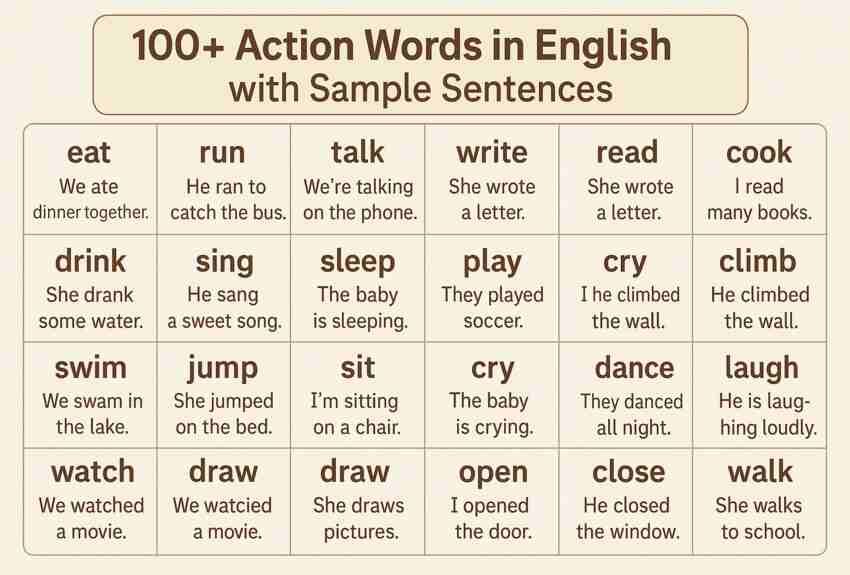
Action words are the foundation of English communication. Action words are usually used to express what animals, people, or objects are doing. Whether you are writing an essay, completing an assignment, improving your spoken English, or preparing for an exam, action words will help you express your emotions in words. These words are also called action verbs, which are used to make a sentence more meaningful and clear.
Action words are mostly used to make any conversation professional. Words like run, eat, and go sometimes look too casual. Instead, analyse, evaluate, and collaborate, using words like this in any academic writing and everyday conversation makes you look more professional. That’s the main reason learning them can significantly improve your vocabulary, grammar and sentence formation skills.
Quick Highlights
Action words are essential for sentence construction because it’s the first grammar concept students learn. Without action words, it would be very difficult to describe activities, movements, thoughts or tasks. Understanding action verbs can help you to improve your writing skills, help you to score well in English exams and communicate effectively in daily basic communication.
What Are Action Words?
Action words are verbs that help you express what a person or animal does. They describe mental activities, physical actions, communication or everyday tasks. Every complete sentence generally contains verbs, and action verbs are among the most commonly used types of verbs in English.
Examples of Simple Action Words
- Run
- Walk
- Eat
- Drink
- Read
- Write
- Speak
- Play
- Jump
- Learn
Sample Sentences
- I run every morning before school.
- She reads a new book every month.
- They play football after classes.
- We learn new topics every day.
These words help readers understand what action is taking place and for which context something is mentioned.
Why Are Action Words Important?
Action words are usually used by almost every person in day-to-day conversation, which makes conversation more effective and engaging. Students who have a strong vocabulary of action verbs perform well in essay writing, answer questions more effectively and speak with more confidence.
Benefits of Learning Action Words
- Improves vocabulary
- Strengthens sentence structure
- Enhances writing skills
- Improves spoken English
- Helps in competitive exams
- Makes communication more effective
Action verbs are especially important in academic writing because they help explain ideas and actions clearly.
Common Daily Use Action Words with Sample Sentences
The verbs that we use on a regular basis in our everyday lives are called daily-use action words. Learning about these verbs will benefit beginners greatly while learning the English language.
Eat
Sentence: I eat breakfast before going to school.
Drink
Sentence: She drinks water regularly throughout the day.
Sleep
Sentence: The baby sleeps peacefully every night.
Walk
Sentence: We walk to the park every evening.
Study
Sentence: Students study hard before examinations.
Cook
Sentence: My mother cooks delicious meals.
Clean
Sentence: He cleans his room every weekend.
Watch
Sentence: They watch educational videos online.
Listen
Sentence: Please listen carefully to the teacher.
Write
Sentence: I write notes during every lecture.
Such elementary words as action words are frequently used in our everyday speech and in class.
Physical Action Words in English
Action verbs refer to physical actions that are undertaken by an individual using their body. Such verbs come in handy when dealing with novice students since they are easy to comprehend and notice.
Run
Sentence: Rahul runs five kilometres every morning.
Jump
Sentence: The child jumps over the rope.
Swim
Sentence: She swims during summer vacations.
Dance
Sentence: They dance at family functions.
Climb
Sentence: We climbed the mountain during our trip.
Throw
Sentence: He throws the ball towards his teammate.
Catch
Sentence: She catches the ball easily.
Kick
Sentence: The football player kicked the ball into the goal.
Ride
Sentence: I ride my bicycle to school.
Lift
Sentence: He lifted the heavy box carefully.
Physical action verbs make descriptions more vivid and engaging.
Action Words Used in School and Education
Students regularly encounter action verbs while studying, learning, and participating in classroom activities.
These words are frequently used in assignments, projects, presentations, and exams.
Read
Sentence: Students read chapters before exams.
Learn
Sentence: We learn new concepts in every class.
Solve
Sentence: She solved all the mathematics questions.
Answer
Sentence: He answered every question correctly.
Explain
Sentence: The teacher explained the topic clearly.
Research
Sentence: Students researched the topic online.
Discuss
Sentence: We discussed the project in groups.
Present
Sentence: They presented their findings confidently.
Analyze
Sentence: The students analysed the survey results.
Evaluate
Sentence: The professor evaluated each assignment carefully.
These action words are particularly useful for academic writing and examination preparation.
Communication Action Words with Sample Sentences
Action words that describe communications include verbs used for talking and interacting with other people.
Speak
Sentence: She speaks English fluently.
Ask
Sentence: I asked the teacher a question.
Answer
Sentence: He answered confidently during the interview.
Explain
Sentence: The manager explained the process clearly.
Suggest
Sentence: She suggested a better solution.
Announce
Sentence: The principal announced the examination schedule.
Inform
Sentence: Please inform me about any updates.
Communicate
Sentence: Good leaders communicate effectively.
Debate
Sentence: Students debated an important social issue.
Persuade
Sentence: The speaker persuaded the audience with strong arguments.
Strong communication verbs help improve both writing and speaking skills.
Advanced Action Words for Vocabulary Improvement
As students progress in English, they should learn more advanced action verbs to improve writing quality and communication skills. These words are often used in academic essays, reports, presentations, and professional settings.
Collaborate
Sentence: Teams collaborate to complete projects successfully.
Investigate
Sentence: Scientists investigate complex problems.
Demonstrate
Sentence: The teacher demonstrated the experiment.
Generate
Sentence: The campaign generated positive results.
Innovate
Sentence: Successful businesses innovate continuously.
Motivate
Sentence: Good leaders motivate their teams.
Organize
Sentence: She organised the event efficiently.
Negotiate
Sentence: The company negotiated a new contract.
Implement
Sentence: The school implemented new policies.
Establish
Sentence: The organisation established a new branch office.
Using advanced action words can make writing sound more professional and polished.
Common Mistakes Students Make with Action Words
Despite learners’ familiarity with action words, it may not be easy for them to apply them correctly within sentences. Knowing the typical mistakes learners commit helps in enhancing their grammatical skills.
- Incorrect
He runs every day.
- Correct
He runs every day.
- Incorrect
She wrote a letter yesterday.
- Correct
She wrote a letter yesterday.
- Incorrect
They were playing football.
- Correct
They were playing football.
Practising action verbs in different tenses helps students avoid these common errors.
How to Learn Action Words Faster
Learning new words involves consistent practice and frequent encounters with these words. One can achieve this by incorporating action verbs in one’s day-to-day interactions.
Effective Learning Tips
- Read books and articles regularly
- Create sentences using new verbs
- Maintain a vocabulary notebook
- Practice speaking in English daily
- Use flashcards for revision
- Watch English educational videos
- Participate in discussions and presentations
Students can retain action words in their minds better when used in practical application.
Conclusion
Action verbs are among the most essential parts of English grammar as they assist in giving descriptions about actions, movements, thoughts, and communication. Ranging from basic verbs such as eat, run, and write to more complex verbs such as analyse, collaborate, and implement, action verbs enrich the language.
By studying and practising action verbs through sample sentences, students will benefit from improved vocabulary, grammar, writing, and confidence in their English speaking.
Frequently Asked Questions
1. What are action words in English?
Action words are verbs that describe what a person, animal, or object is doing.
2. What is another name for action words?
Action words are commonly called action verbs.
3. Why are action words important?
They help make sentences meaningful and improve communication skills.
4. What are some common action words?
Run, walk, eat, drink, read, write, speak, and learn.
5. How can students learn action words easily?
Students can learn action words through reading, writing practice, conversations, and vocabulary exercises.
6. Are action words used in essays?
Yes, action verbs are essential for writing clear and engaging essays.
7. What are physical action words?
Physical action words describe body movements such as run, jump, swim, and climb.
8. What are communication action words?
Communication verbs include speak, ask, explain, discuss, and communicate.
9. Can action words improve English speaking skills?
Yes, learning more action verbs helps students express themselves more confidently and accurately.
10. What is the best way to remember action words?
Using them regularly in sentences and conversations is the most effective way to remember action words.