

For more than a century, a large number of people seem to be inclined towards medical studies. Being a medical doctor is unquestionably a dream of numerous students without a second thought. On one hand, it builds a permanent career; on the other hand, it provides you with a golden opportunity to serve people. If you are a medical practitioner, you are employed all the time. Even if you don’t get a job, you have the option to open your clinic or see patients at home.
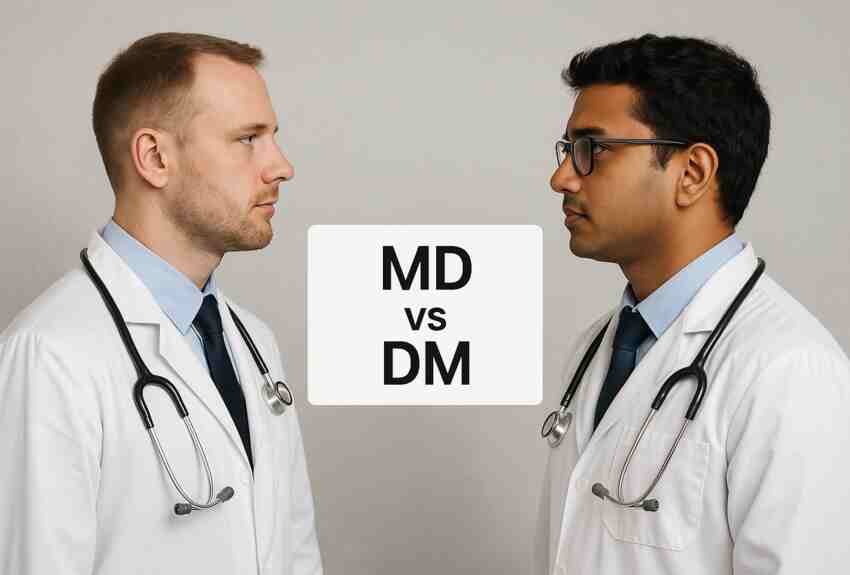
There are several medical degrees that students do to get medical education. First of all, they study MBBS to acquire medical education. But many students like to get higher degrees for their growth, which are MD and DM. These two popular degrees help students a lot in building a perfect career in the medical field. Let’s compare these two degrees to understand the difference between the two. MD is necessary if you have to do DM, and the following details may help you understand whether MD is sufficient for you or you should go further to pursue DM.
Difference in the Courses
MD refers to “Doctor of Medicine” and DM refers to “Doctorate of Medicine”. MD is a postgraduate degree, which is pursued after completing an MBBS, taking 3 years to specialize in a broad medical field like general medicine, pediatrics, or radiology. On the other hand, DM refers to a super-specialty degree that is pursued after completing an MD. It generally takes another 3 years and focuses on a highly specialized area of medicine such as cardiology, neurology, nephrology, gastroenterology, or endocrinology.
In simple words, MD provides in-depth knowledge in a particular branch of medicine, while DM offers advanced expertise in a sub-specialty within that branch. Therefore, DM is considered a higher qualification than MD in the medical education hierarchy.
Eligibility Criteria
The eligibility requirements for these two degrees are different. To pursue an MD degree, a candidate must complete an MBBS degree from a recognized medical institution and obtain the required internship training. Admission to MD programs is usually based on entrance examinations and merit.
For pursuing a DM degree, candidates must first complete an MD degree in the relevant specialization. Only after obtaining an MD can a student apply for a DM program in a suitable super-specialty. Since DM is an advanced course, the admission process is highly competitive and requires excellent academic performance.
Scope and Career Opportunities
Both MD and DM provide excellent career opportunities in the medical field. However, the level of specialization creates different career paths.
After completing an MD, doctors can work in government hospitals, private hospitals, nursing homes, medical colleges, research organizations, and healthcare institutions. Many doctors also establish their private clinics and practice independently. MD specialists are always in demand due to their expertise in diagnosing and treating a wide range of medical conditions.
On the other hand, DM graduates enjoy even greater career prospects due to their super-specialized knowledge. Since they are experts in a particular medical discipline, they are often preferred for senior consultant positions in reputed hospitals. DM specialists are also involved in handling complex medical cases that require advanced treatment and procedures.
Salary Comparison
Salary is one of the important factors that influence students when choosing a career path; therefore, it will be worth comparing when talking about “MD vs DM”. Both MD and DM doctors earn attractive salaries, but DM specialists generally receive higher compensation because of their advanced qualifications and expertise.
An MD doctor can earn a respectable income in both government and private healthcare sectors. The salary increases with experience, skills, and reputation. A DM specialist usually enjoys better earning opportunities as hospitals and healthcare organizations highly value their specialized knowledge. Moreover, specialists with their own practice can generate substantial income over time.
Popular Specializations
There are several specializations available under both MD and DM programs.
Some common MD specializations include:
- General Medicine
- Pediatrics
- Dermatology
- Radiology
- Psychiatry
- Anesthesiology
- Pathology
- Pulmonary Medicine
Some popular DM specializations include:
- Cardiology
- Neurology
- Nephrology
- Endocrinology
- Gastroenterology
- Medical Oncology
- Clinical Immunology
- Hepatology
Students can choose a specialization based on their interests, career goals, and professional aspirations.
Which Degree is Better?
It is difficult to declare one degree better than the other because both serve different purposes. MD is an essential postgraduate qualification for doctors who want to gain specialized medical knowledge and build a successful career. Without completing MD, a student cannot pursue DM.
On the other hand, DM is ideal for those doctors who wish to become experts in a particular super-specialty and handle advanced medical conditions. It offers greater expertise, recognition, and career advancement opportunities.
Therefore, the choice depends entirely on the career objectives of an individual. If a doctor wants to practice in a broad specialty, MD is sufficient. However, if someone wishes to become a super-specialist and achieve a higher position in the medical profession, pursuing a DM degree can be a rewarding option.