

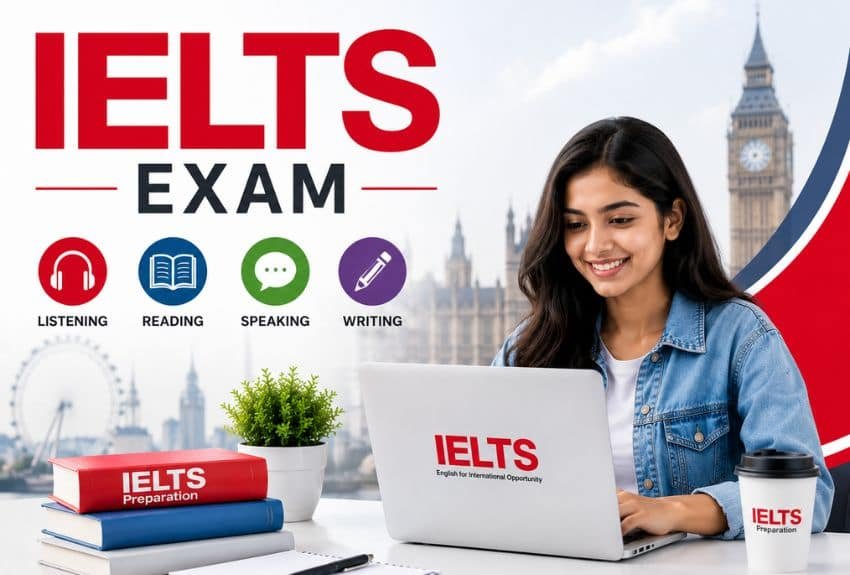
When you decide to visit a Western country for higher studies, one of the major things you need is to prove your English proficiency, especially if you are not a native English speaker. To do this, you need to qualify for an English proficiency test that is recognized worldwide. One such exam is IELTS, which stands for the International English Language Testing System. This exam is administered globally by the British Council, IDP, and Cambridge. Here you will get the details about IELTS.
What is IELTS?
IELTS is an exam that is aimed at people who are willing to study in an English-speaking environment. This exam is also aimed at people who want to emigrate or work in an English-speaking country. Moreover, this exam can be useful for you in your own country, as well as where English proficiency is a prerequisite.
How to Register for an IELTS Exam
You need to visit the IELTS Online Registration Platform first. Then you are required to complete the online registration form for an IELTS exam. Scan your passport and national e-ID card. Then you will receive a confirmation email. Processing and confirmation may take 48 hours.
Test Dates & Centers
There are different dates in different cities. In India, the upcoming dates are in June and July. However, these tests are organized in different months. You can find the centers in most of the big cities in India. If you belong to another country, you can check the centers in your country on the authorized websites. In India, you can get the centers in the following cities and locations. Here are some of the centers in India.
- Ahmedabad-West
- Ambala
- Amritsar
- Anand
- Angamaly
- Barnala
- Bathinda
- Bengaluru
- Calicut
- Chandigarh
- Chengannur
- Chennai
- Coimbatore
- Dehradun
- Firozpur
- Gurdaspur
- Gurugram
- Guwahati
- Hoshiarpur
- Hyderabad
- Indore
- Jaipur
- Jalandhar
- Jammu
- Kannur
- Karnal
- Khanna
- Kochi
- Kolkata
- Kollam
- Kothamangalam
- Kottayam
- Lucknow
- Ludhiana
- Madurai
- Mangalore
- Mehsana
- Moga
- Mumbai-West
- Mysore
- Nadiad
- Nagpur
- Navi Mumbai
- Navsari
- Nawanshahr
- New Delhi-South
- New Delhi-West
- Noida
- Patiala
- Pune
- Raikot – Punjab
- Raipur
- Rajkot – Gujarat
- Rudrapur
- Sangrur
- Sri Ganganagar
- Surat
- Thane
- Thrissur
- Tiruchirappalli
- Trivandrum
- Vadodara
- Vijayawada
- Visakhapatnam
Result & Score
IELTS exams are graded from 0 to 9. If you get a grade of 9.0, then you are considered an expert user. If you get 8.0, then you are a very good user. The score 7.0 is for a good user. The 6.0 score indicates that you are a competitive user. The score 5.0 is for a modest user.
To check the result, you need to log in to your IDP IELTS Results or the British Council Test Taker Portal. You can log in through your passport and candidate details. However, the online result is considered provisional; therefore, you need to wait for your physical Test Report Form (TRF).
Tips for Preparation of the IELTS Exam
Here are some tips for preparation of IELTS:
1. Use Grammatical Structure Instead of Memorizing the Answer
When you take speaking and writing tests, it is expected by the examiner that your answers should be natural. It can be told by the examiner whether your answer is memorized. It can further influence your final band score. This is why you are advised to use grammatical structure instead of memorizing the answer.
2. Do a Proper Practice Using the Right Practice Material
There is an old quote, which says that practice makes a person perfect. If not perfect, it is for sure that practice can make you proficient. Therefore, practice is a major key to achieving success in the IELTS paper. You can get the right practice material online easily. Besides, classes are also conducted for IELTS papers, which you can attend for the practices purpose.
3. Do Listening Practice
There are multiple speakers in Part 1 and Part 3 of the listening test of IELTS. Therefore, a wonderful idea for you is to practice your listening with numerous dialogues, such as a discussion panel or a TV drama. In Part 2 and Part 4 of the IELTS listening test, you get one speaker for 5-7 minutes. So, the good idea may be listening to a short video lecture of similar length.
ConclusionAn
IELTS paper makes you eligible to study abroad, work abroad, and stay abroad (for immigration). Besides, this exam makes you eligible for several vacancies where you need English proficiency. You can get preference in jobs even in your own country. Besides, it also helps you in knowing about your proficiency, and it makes you confident about your skills.
Frequently Asked Questions
1. What is the IELTS exam?
IELTS (International English Language Testing System) is an English proficiency exam accepted for study, work, and immigration in English-speaking countries.
2. Who conducts the IELTS exam?
IELTS is jointly conducted by the British Council, IDP Education, and Cambridge Assessment English.
3. How can I register for the IELTS exam?
Students can register online through the official IELTS registration portal by filling out the application form, uploading ID proof, and paying the exam fee.
4. What is the IELTS exam fee in India?
The IELTS exam fee in India generally ranges around ₹17,000–₹18,000 depending on the test type and location.
5. What is the IELTS band score system?
IELTS scores range from 0 to 9 bands. A score of 9 indicates an expert user, while 6–7 bands are commonly accepted by many universities.
6. How can I check my IELTS result?
You can check your IELTS result online through the IDP IELTS portal or British Council Test Taker Portal using your passport and candidate details.
7. Is IELTS required for study abroad?
Yes, IELTS is commonly required for admissions, student visas, and immigration in countries like the UK, Canada, Australia, Ireland, and New Zealand.
8. How long is the IELTS score valid?
IELTS scores are valid for two years from the test date.
9. What are the sections in the IELTS exam?
The IELTS exam has four sections: Listening, Reading, Writing, and Speaking.
10. Is IELTS difficult for Indian students?
The difficulty level depends on English proficiency and preparation. Regular practice and proper guidance can help students achieve a good band score.
11. How can I prepare for the IELTS exam?
Students should practice listening, reading, writing, and speaking regularly using official IELTS practice materials and mock tests.
12. What is a good IELTS score for universities?
Most universities accept scores between 6.0 and 7.5 bands, depending on the course and institution.