

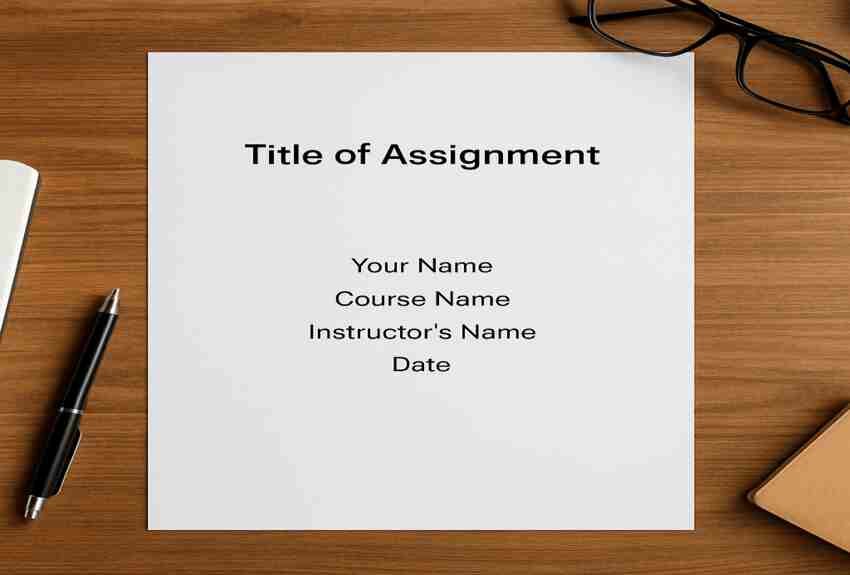
An excellently formatted cover page not only leaves an impression on the reader but also ensures that your assignment looks professional. Be it for your school, college, university or even any research project, having a cover page for it ensures that all essential information is communicated at one glance.
The cover page is the opening page of your assignment. It gives relevant information concerning the assignment itself. An effectively designed cover page creates a good impression of the entire assignment since it makes the assignment easy to identify by the tutor.
Why Is a Cover Page Important?
The cover page is not just any other page that forms the first page in the document; rather, it forms part of the identity of your assignment. Information such as the title of the assignment, the student’s name, the course name, and the date of submission are some of the vital pieces of information included on the cover page that will help in easily identifying the document.
According to professionals in academic writing, assignments that have been well-formatted tend to be easier to mark. Although the contents of the assignment are the main determinant of the final grade, formatting plays an equally significant role in enhancing its overall appearance.
Benefits of a Good Cover Page
- Creates a professional first impression
- Makes assignments easy to identify
- Improves presentation and organisation
- Demonstrates attention to detail
- Helps instructors manage submissions efficiently
Most universities have a presentation included in the marking rubric of the assignment.
Essential Elements of an Assignment Cover Page
Prior to making your cover page for an assignment, there needs to be a basic understanding of what should be included in a cover page. An effective cover page allows tutors to easily recognise your submission and ensure that all submission guidelines have been adhered to. Although each university will provide different requirements, there is usually a standard format of requirements.
An effective cover page is professional and organised, free of any design clutter. It should mainly comprise important information.
Information to Include on an Assignment Cover Page
- Assignment Title – The name of the assignment, project, report, or research paper.
- Student Name – Your full name as registered with the institution.
- Student ID or Roll Number – Helps instructors identify your submission.
- Course Name – The program or course for which the assignment is being submitted.
- Subject or Module Name – Specifies the particular subject related to the assignment.
- Instructor or Professor’s Name – The faculty member responsible for assessing the work.
- Department Name – Relevant academic department, if required.
- Institution Name – School, college, or university name.
- Submission Date – The deadline or date on which the assignment is submitted.
- Institution Logo (Optional) – Some institutions require their official logo on the cover page.
Standard Assignment Cover Page Format
Assignment cover pages should have a clean design that allows for easy reading of all the necessary information contained. Generally, most institutions of learning recommend the use of a neat and straightforward design of a cover page, featuring clear heading lines, proper spacing, and alignment.
The process of designing cover pages for assignments differs from one institution to another, although the basic design elements remain more or less the same. It is advisable to read institutional guidelines before undertaking any assignment.
| Typical Assignment Cover Page Layout | |
|---|---|
| Section | Information Included |
| Institution Name | School, college, or university name |
| Assignment Title | Title of the assignment or project |
| Student Information | Full name and student ID/roll number |
| Course Details | Course name and subject/module |
| Instructor Details | Professor or instructor’s name |
| Department | Relevant academic department |
| Submission Date | Assignment submission date |
| Institution Logo (Optional) | Official logo if required |
Formatting Tips
- Use professional fonts such as Times New Roman, Arial, or Calibri.
- Keep the font size between 12 and 14 points for most text.
- Make the assignment title larger and bold for emphasis.
- Maintain consistent spacing throughout the page.
- Align content neatly, typically in the centre of the page.
- Avoid excessive colours, graphics, or decorative fonts unless specifically permitted.
It is impossible to make your assignment better using an assignment cover page, but this document will allow your reader to form a good impression of your work.
How to Create a Cover Page in Microsoft Word
Microsoft Word is one of the most commonly used software tools used to help create assignment cover pages. This software application offers many ways of creating an attractive cover page by providing you with a variety of templates and designs. It won’t take much time for you to come up with an attractive cover page for your assignment.
The key thing to consider in the process of making an assignment cover page is its structure. An assignment cover page should always have a proper structure and meet all formatting requirements put forward by your educational establishment.
Step-by-Step Process
- Open a new Word document.
- Insert the institution logo if required.
- Add the assignment title in a larger font size.
- Enter student and course details.
- Align content neatly in the centre.
- Use professional fonts such as Times New Roman, Arial, or Calibri.
- Check spelling and formatting.
- Save the document before submission.
Cover Page Design Tips
Your paper will appear more organised if you pay attention to its cover page design. Though the substance of your assignment is more important, a properly designed cover page will definitely leave a good impression on your readers. Ideally, a proper cover page should be uncluttered and simple-looking instead of colourful and graphic-rich.
Best Practices
- Use readable fonts
- Keep font sizes consistent
- Maintain adequate spacing
- Avoid excessive colors
- Use bold headings where appropriate
- Follow university formatting guidelines
- Proofread all information before submission
Common Mistakes to Avoid
Creating an effective cover page will give the reader a great first impression, but students often get poor grades due to minor slip-ups. These are some of the most common mistakes that you can easily avoid.
Avoid These Errors
- Missing student details
- Incorrect assignment title
- Spelling mistakes
- Using too many fonts
- Poor alignment
- Low-quality logos
- Overcrowded design
Cover Page Example for College Assignments
In the case where your institution does not supply a designated template for an assignment cover page, the following general format can be considered:
- University name
- Assignment title
- Student name and ID
- Course and subject
- Professor’s name
- Department
- Submission date
The formatting details might differ from one setting to another.
Digital vs Printed Assignment Cover Pages
As more and more colleges/universities start accepting assignments submitted online, there arises a requirement for creating electronic as well as hard copies of the assignment. Although the information included in the cover page will be similar for all types of assignments, yet different formatting techniques may apply.
Digital Submission
- Save as PDF when possible
- Ensure formatting remains intact
- Use high-quality logos and images
Printed Submission
- Use quality paper if required
- Ensure margins are correct
- Print a final proof copy before submission
Student Reality Check
A cover page alone will not help you get better grades in assignments, but a professionally formatted cover page demonstrates your level of professionalism and detail. Together with quality content, appropriate formatting can definitely impress your professor.
Conclusion
Preparation of a cover page for your assignment is easy and crucial. Having a professional cover page will not only help in organising your assignment properly but will also provide you with the necessary details and leave a positive impression. It is all about including proper information and following the proper guidelines provided by your educational institute to make your assignment look professional.
Frequently Asked Questions
1. What should be included on an assignment cover page?
An assignment cover page should include the assignment title, student name, student ID or roll number, course name, instructor’s name, institution name, and submission date.
2. Is a cover page mandatory for all assignments?
Not always. Some schools, colleges, and universities require a cover page, while others may not. Always check your institution’s submission guidelines.
3. How do I create a cover page in Microsoft Word?
You can create a cover page in Microsoft Word using the built-in Cover Page feature or by manually adding the required details and formatting them professionally.
4. What is the standard format of an assignment cover page?
A standard cover page typically includes the assignment title at the center, followed by student details, course information, instructor details, and the submission date.
5. Which font is best for an assignment cover page?
Professional fonts such as Times New Roman, Arial, Calibri, and Cambria are commonly recommended. Font sizes between 12 and 14 points are generally preferred.
6. Can I add images or graphics to my assignment cover page?
Yes, but only if your institution allows it. Most academic cover pages should remain simple, clean, and professional.
7. Should I include my college or university logo on the cover page?
You should include the logo only if it is required by your institution or specified in the assignment guidelines.
8. What is the difference between a digital and a printed cover page?
A digital cover page is submitted electronically with an assignment, while a printed cover page is attached to a physical copy of the assignment.
9. How can I make my assignment cover page look professional?
Use consistent formatting, proper alignment, readable fonts, adequate spacing, and accurate information while avoiding unnecessary design elements.
10. What are the most common mistakes students make on cover pages?
Common mistakes include missing details, spelling errors, incorrect formatting, poor alignment, and failing to follow institutional guidelines.